ITT@eric is documenting his personal guitar collection and his knowledge of the instrument. Readers are invited to ask questions, offer tips, and share their own guitars in the subsequent discussion.
This post contains affiliate links. This site receives commissions upon sales generated from such links. Thank you for your support!
My guitar collection is fairly minimalist. I like to be consistent with brands, and I prefer to have a few nice instruments to many lower-quality ones. I’ve owned many other guitars over the years, and traded up many times to arrive at the current collection. Not being sentimental about the instruments has allowed me to develop the current lineup, with which I am quite happy. I feel this current collection is more worthy of my sentimentality. Even so, I usually do not name my guitars.
Martin
000-17
The 000-17 is the main acoustic guitar I like to use for recording at home. I purchased it from Harry’s Guitar Shop in Raleigh, NC. This is a locally-owned guitar shop with many beautiful instruments. I highly recommend this store.
When not in use, I keep this guitar in a hard-shell case with a humidifier in the sound hole.
The LX1E is a compact guitar that I obtained specifically for Travel and public performance. I purchased mine from Guitar Center, also in Raleigh.
I use standard Martin strings on both acoustic guitars.
Gibson
Les Paul
For electric guitar, I use a 2020 Gibson Les Paul Standard with an iced tea burst finish. I purchased it from Sam Ash Guitars in Raleigh, NC, which, sadly, has closed.
As I will discuss below, I use my computer in place of an amplifier. I use Ernie Ball strings on my Les Paul.
Recording
The 000-17 is acoustic only, and needs to be recorded using microphones. The Les Paul is connected directly to an audio interface to be processed by Guitarix. The LX1E, being acoustic electric, can be recording using either method. All guitars and microphones are connected to the Zoom H8 as the audio interface for either the Dell Tower Plus Desktop or the Dell Latitude 7230 Rugged Extreme Tablet.
The all-fourths guitar tuning system (E-A-D-G-C-F or Eb-Ab-Db-Gb-Cb-Fb) aims to preserve symmetries and visual patterns on the fretboard during transposition across strings. This is achieved by raising the high B and E strings each by a half step, creating an interval of a perfect fourth between adjacent strings. By contrast, standard tuning contains a major third between G and B, which creates comfortable chord shapes when using open strings, but also requires adjustments to visual patterns when transposed across the asymmetry. Using a symmetric tuning system such as all-fourths reduces the number of visual patterns needed to learn chords and scales on the guitar by two thirds.
A few prominent guitarists have used this tuning, Stanley Jordan being the most relevant to me since I have seen him in concert.
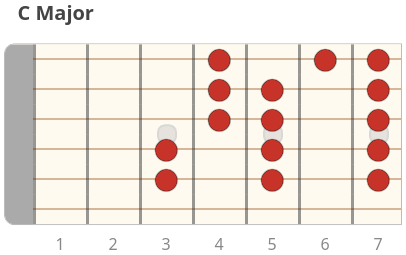
Using all-fourths tuning, this two-octave, single-hand-position, major scale pattern can be transposed across strings and frets, and will be the basis for learning the other patterns listed here. Notice that each string utilizes three notes in one of two patterns: two whole steps or a whole step and a half step. These two patterns will come back again and again throughout this exercise.
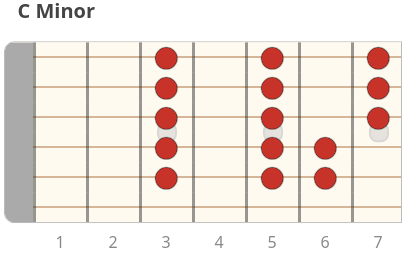
For minor scales, the pattern basically inverts. The major scale had two whole steps for the lower (as in pitch) two strings and a whole step and a half step for the higher three, while the minor scale does the opposite.
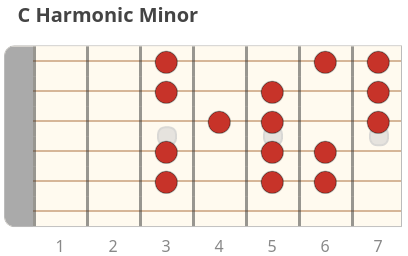
Harmonic minor is constructed by raising the seventh scale degree to a half step, adding a leading tone to the scale. I find this one requires a different finger pattern when played ascending vs descending.
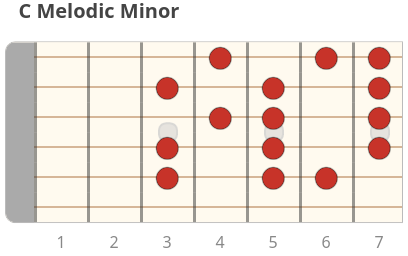
Melodic minor is constructed by raising the sixth scale degree a half step to remove the augmented second created by harmonic minor.
Arpeggios
These patterns are excellent for constructing arpeggios. Simply playing every other note feels quite comfortable, though, again, harmonic minor requires special attention. I find it useful to practice each scale and arpeggio on each fret of the E and A string (though I often only do A). Theoretically, one could play a lot of music knowing these patterns, the pitches of the A string, and how to pair scales with chords.
Triads
The above scales are less useful when attempting to construct triads; luckily, there are only a few basic patterns one needs to learn in order to understand them:
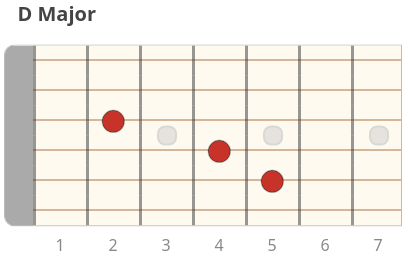
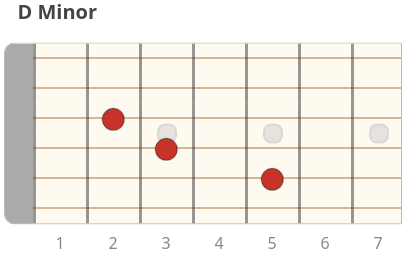
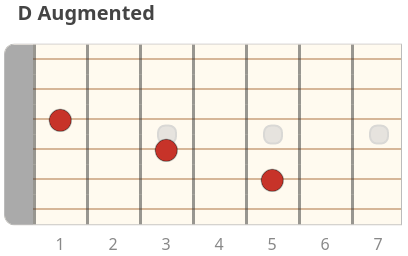
In this example of a closed, root-position major triad, the basic pattern of intervals between strings can be seen: from a lower string to a higher string, moving down by one fret creates a major third while two creates a minor third. This knowledge alone can allow one to construct all root-position triads, which, again, can be transposed across strings.
Of course, there are still inversions, seventh chords, inversions of seventh chords, etc. to be learned; however, one would have to learn two additional shapes for each of these examples in order to transpose them to the D and G strings in standard tuning. With intervals across strings now consistent, it becomes much easier to construct these chords based on visual reference points. I find knowing that a typical “power chord” consists of a root, perfect fifth, and an octave also helps provide some useful relative landmarks.
Limitations
I have already mentioned that chord shapes built around open strings no longer work in this system; further, most repertoire is written for standard tuning explicitly to utilize that feature. Even so, I have found it fairly easy to adapt most of the music I want to play to accommodate. Now that I have become accustomed to all-fourths tuning, I find I often have an easier time playing and learning music using it. There are some pieces that become impossible to play (I haven’t figured out Welcome to the Jungle yet), but ultimately I have found all-fourths tuning to be a logical system that allows me to apply music theory to the fretboard much more easily.
ITT @eric is documenting his personal guitar collection and his knowledge of the instrument. Readers are invited to ask questions, offer tips, and share their own guitars in the subsequent discussion.
This post contains affiliate links. This site receives commissions upon sales generated from such links. Thank you for your support!