Recommended Procedure for Salting Out Ethanol
Materials
- Mason jar with lid (or any sealable glass container)
- Graduated cylinder (or other volume-measuring glassware)
- Pipette
- Several coffee filters
- Potassium carbonate (K₂CO₃)
- Ethanol-containing mixture (e.g., fermented wash, low-purity alcohol)
Acceptable Alternatives
- Narrow straw or turkey baster instead of a pipette
- Optional: water already saturated with potassium carbonate from a previous salting-out run
Procedure
- Clarify the starting ethanol mixture
- Strain out any solids from the starting ethanol mixture using a coffee filter, or
- Distill it once to remove most solids and starting ethanol mixture
- Note: doing both is acceptable and recommended to removed dissolved sugars and mineral.
- Transfer to a sealable container
- Pour the clarified ethanol-containing liquid into a mason jar or another watertight, sealable container.
- (Optional) Add recycled brine
- If you have water from a previous salting-out run that is already saturated with potassium carbonate, add it to the container used in step 2.
- If you don’t have this, skip this step.
- Add potassium carbonate
- Add a generous amount of potassium carbonate to the jar.
- Seal the container
- Tighten the lid on the mason jar or seal your container well.
- Shake to dissolve
- Shake vigorously until all visible potassium carbonate has dissolved.
-
Repeat until saturated
-
If all the potassium carbonate dissolves, add more K₂CO₃ and repeat step 6.
-
Continue until some undissolved potassium carbonate remains at the bottom. This indicates the solution is saturated or close to saturated.
- Let the mixture settle
2. Set the jar down and allow it to stand until two clear layers form:- A denser, water-rich (salt solution) layer. (lower layer
- A lighter, ethanol-rich layer (upper layer)
Separation Options
You can now separate the layers using either a separatory funnel (preferred) or improvised glassware.
Option A: Using a Separatory Funnel
- Prepare the separatory funnel
- Place a coffee filter over the top of the separatory funnel (do not push coffee filter inside the funnel body; you’ll need to remove it later).
- The filter will catch any undissolved solids or potassium carbonate crystals.
- Transfer the salted mixture
- Unseal the jar containing the potassium-carbonate-treated mixture (from steps 1 to 8).
- Pour it through the coffee filter into the separatory funnel until either:
- The funnel is full, or
- The entire jar is empty.
- Drain the bottom (water/salt) layer
- Once the layers have clearly separated, open the stopcock and drain off the bottom layer (the dense, water-rich potassium carbonate solution).
- Close the stopcock before any of the top, ethanol-rich layer starts to flow out.
- Collect the ethanol-rich layer
- Pour or drain the remaining top layer (the ethanol-rich layer) into a clean, sealable container such as a mason jar.
Option B: If You Don’t Have a Separatory Funnel
- Set up improvised separation glassware
- Place a funnel on top of a tall, narrow container (a graduated cylinder-style shape works best). Note, any container will suffice; narrow container will make ethanol extraction easier
- Put a coffee filter inside the funnel to catch solids.
- Transfer the salted mixture
- Unseal the jar from steps 1 to 8.
- Pour the mixture through the coffee filter into the tall, narrow glassware until the container is full or the jar used in steps 1 to 8 is empty.
- Let the mixture sit until two clear layers form.
- Remove the ethanol-rich top layer
- Use a pipette or a turkey baster to carefully remove the top layer (the ethanol-rich layer) and transfer it into a new, clean, sealable container (e.g., a mason jar).
- If you don’t have a pipette or baster, you can use a narrow straw:
- Place one end of the straw into the top layer.
- Cover the other end of the straw with your finger to hold the liquid.
- Move the straw to your clean container and release your finger to dispense the liquid.
Handling the Remaining Materials
- Collect solid potassium carbonate and filters
- Any coffee filters that contain solid potassium carbonate can be placed, filter and all, into a sealable plastic bag (e.g., a Ziploc bag) for storage or later reuse.
- Dry the potassium-carbonate solution for reuse (optional)
- The remaining water layer, which is highly saturated with potassium carbonate, can be left in an open container to dry in air.
- Not recommended to use a dehydrator: potassium carbonate will condense onto the container walls and be harder to collect, and require water to remove from the side of the containers.
- Further purification of ethanol (if needed)
- The salting-out step separates water and many dissolved substances from the ethanol, but some organic compounds (e.g., sugars) may still remain in the ethanol-rich layer.
- A follow-up distillation step is recommended if you need purer ethanol, especially to separate ethanol from dissolved sugars or other organics.
Safety and Handling Notes
- Hygroscopic nature of potassium carbonate
- Do not leave potassium carbonate exposed to air. It is strongly hygroscopic and will absorb water from the atmosphere.
- Do not ingest the saturated solution
- The water that is saturated with potassium carbonate is not safe to drink.
- It tastes extremely caustic—“like battery acid but stronger”—and can cause harm.
Salting out Versus distillation
I recommend salting out as a way to achieve higher purity than can be obtained with distillation alone. I used the partial pressures of water and ethanol at different temperatures to estimate the achievable purity.
At 70 °C, ethanol has a partial pressure of 72.28 kPa and water has a partial pressure of 31.2 kPa, which corresponds to an ethanol volume fraction of about 69.85%. At 20 °C, ethanol has a partial pressure of 5.85 kPa and water has a partial pressure of 2.4 kPa, corresponding to an ethanol volume fraction of about 83.78%. The equation  was used for estimating the partial pressure of ethanol was used, and the partial pressure of water was obtained from online lookup tables. These last two values are my own estimates for a distillation-only setup.
The recommended boiling temperature for ethanol distillation is 78 °C, but I am convinced that, in a simple setup, the concentration cannot go much above 70% ethanol by volume. Multiple sources claim that distillation can reach around 95% ethanol by volume, but I remain skeptical due to the lack of direct verification and the possibility that my ignorance on mechanism, such as fractional distillation, that improves the alcohol content. I can confirm that, using molecular sieves and desiccants, it is possible to obtain ethanol very close to 100% by volume (see this video).
Salting out has the advantage of using less material and less energy than distillation while still achieving very high ethanol concentrations, and the potassium carbonate can be reused. With pure distillation, all of the water must be heated. With salting out, much of the water can instead be removed physically, rather than by putting heat energy into the water–ethanol mixture and supplying the additional energy required to vaporize ethanol. Furthermore, in distillation, the heat energy added to the system is ultimately rejected into a cold reservoir; this loss can largely be avoided by using salting out.
Evidence, Measurements, and Theory (Summary)
- This procedure was tested using vodka, which nominally contains only ethanol and water, but which often has trace organic compounds (flavorings, congeners).
- Salting out works better as the concentration of potassium carbonate increases, up to the point of supersaturation, where additional solid potassium carbonate remains undissolved.
Density-Based Purity Estimation
Assuming the salted-out liquid phase only contains water and ethanol, and potassium carbonate remains mostly in a separate (aqueous) phase:
- Let:
- W = volume fraction of water
- E = volume fraction of ethanol
- D = measured density of the mixture (g/mL)
We assume:
- W+E=1
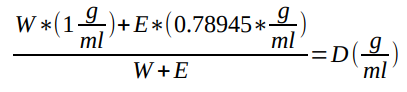
Given known densities of water and ethanol at a given temperature, you can solve for E (ethanol volume fraction). A derived quick-reference linear equation (for room temperature conditions) is approximately:
- Ethanol volume fraction ≈4.74947−4.74947*D
Where:
- D is measured using a scale and any container with a known volume.
- Be aware that the densities of water and ethanol are temperature-dependent, so for accurate measurements, you must adjust for temperature.
Example Measurement
- A measured density of roughly 0.80g/mL (e.g., (33−9) g/30 mL) is close to the density of ethanol at room temperature.
- This suggests a purity around 94% ethanol by volume.
However, measurement accuracy is limited by:
- Scale resolution (±1 g changes cause a large swing in calculated purity).
- Volume-reading resolution (±1 mL changes also significantly shift the result).
For instance, with the same base readings:
- Adding 1 g to the measured mass might drop calculated purity from ~94% to ~82%.
- Subtracting 1 mL from the measured volume might drop it to ~72%.
- Changing both can reduce the calculated purity to around ~60%.
This shows that better measuring equipment (more precise scale and volumetric glassware) is important for accurate purity estimates.
Flame Test Observation
- A crude flame test was done by igniting the ethanol-rich layer:
- No obvious solid residue remained, suggesting low amounts of non-volatile solids.
- The aluminum can used as a test surface became more hazy/white, but there was no residue visible on a fingertip after wiping.
- This is only a qualitative indication and not a reliable purity test.
Reusing Potassium Carbonate: Common Issues
Reusing potassium carbonate and its solutions can work, but several problems often arise:
- Gradual accumulation of water, which requires adding more potassium carbonate to reach saturation again.
- Coffee filters retaining solid potassium carbonate.
- Poor layer separation when using water already saturated with potassium carbonate (sometimes layers fail to separate cleanly).
- The ethanol-rich layer can become very thin, making it difficult to remove with a pipette or straw.
- Solid potassium carbonate can crust onto jar walls and is difficult to scrape off; water is usually needed to dissolve it first for recovery, which again introduces more water.